
Paver Walkway Installation in
Vineland, NJ
Vineland Paver Pros designs and installs smooth, durable paver sidewalks and walkways for homeowners in Vineland and the surrounding area. Call or fill in our form today to schedule your free on-site estimate.
20+
Years of Experience
600+
Jobs Completed
4.9
Average Star Rating
48Hr
Estimate Turnaround
Paver Sidewalks That Are Safe, Smooth, and Welcoming
A paver sidewalk is a durable walking surface made of interlocking pavers set over a compacted aggregate base and a layer of bedding sand. It connects your driveway, front door, garage, and backyard, and it is built to stay level through years of foot traffic and weather. The pavers work together as a flexible system, so the surface handles ground movement and temperature swings without cracking.
It is ideal for homeowners with a cracked, uneven, or stained concrete walkway, loose stepping stones, or a path that turns muddy and slippery in wet weather. The best time to act is when sections first start to sink or lift, before a small tripping hazard turns into a full replacement.
When the job is done right, you get a smooth, safe, good-looking walkway that drains well and boosts curb appeal. If a paver is ever damaged or stained, it can be replaced without tearing out the whole path.
Is It Time for a New Walkway? Here Is How to Tell
A paver sidewalk makes sense for homeowners whose current walkway is cracked, heaving, sinking, or stained beyond repair. It is also a good fit if tree roots are lifting sections, if you have a worn path across the lawn from the driveway to the door, or if you want to connect the front of your home to the backyard patio. Many homeowners also add a new walkway when preparing to sell, because the front entrance shapes first impressions.
The best time to act is when the first signs of trouble appear. A raised edge or a sunken section may seem minor, but it is a tripping hazard for children, older family members, and delivery drivers. Spring and fall are popular in our region because the ground is workable and the weather is comfortable, but walkways can be installed through much of the year, and planning ahead often gets you a better spot on our schedule.
If you choose not to replace a failing walkway, the problem tends to grow. Cracks fill with water that freezes and widens them every winter, uneven sections become more dangerous, and puddles collect in low spots and turn icy in cold weather. Patching rarely matches the original surface, and many homeowners end up paying for a full replacement after years of repeated repairs.
A Proven Process for a Walkway That Stays Smooth and Level
Every project starts with a free on-site estimate. We visit your home, measure the route, look at the slope and drainage, and talk through how you use the space. We discuss the width, shape, paver styles, colors, and patterns, and any extras like borders, steps, or lighting. You then receive a clear written quote, and once you approve it we schedule the work and mark out underground utility lines before any digging begins.
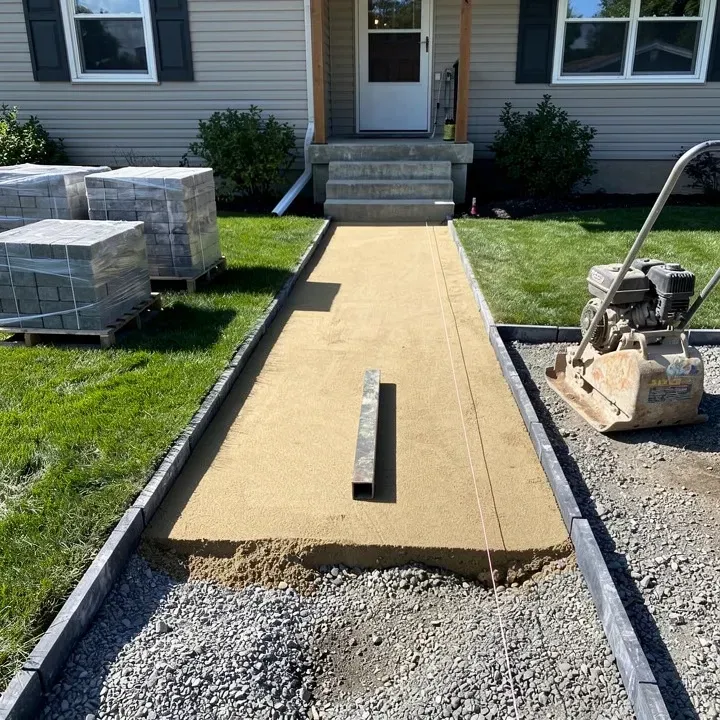
On installation day, we lay out the path and set the finished height so it meets your doorway, steps, and driveway correctly and slopes gently to shed water. We remove the old surface or sod, excavate to the proper depth, and compact the soil underneath. We then install crushed aggregate in thin layers, compacting each one with a plate compactor until the base is firm, dense, and perfectly graded.
Once the base is ready, we install edge restraint along both sides and spread a smooth layer of bedding sand, screeded to the correct level. The pavers are laid by hand in your chosen pattern with tight, even joints. We cut pavers along curves, steps, and borders with a saw for clean edges, then compact them into the sand, sweep polymeric joint sand into every joint, and compact once more so the surface locks together.
To finish, we activate the joint sand, clean the surface, grade soil along the edges, and remove all debris. We then walk the finished sidewalk with you and review simple care tips. You get a stable, level, slip-resistant walkway that is ready to use right away.
What Affects the Cost of a Paver Sidewalk
The cost of a paver sidewalk depends on several factors, and understanding them helps you plan with confidence. Length and width are the biggest ones, since a longer or wider walkway requires more material, excavation, and labor. Shape matters too. A straight path is more efficient to build than one with curves, angles, or multiple branches, which require more cutting and layout time.
The type of paver you choose also affects the price. Standard concrete pavers are the most budget-friendly, while premium concrete pavers, larger formats, and natural stone cost more. Pattern plays a role as well, because a simple running bond is quicker to install than a herringbone or a design with contrasting borders and inlays.
Site conditions have a major impact. Removing an old concrete walkway, hauling away debris, and dealing with soft soil, tree roots, or a sloped yard all add time and material. Drainage is another factor. Paths that need extra base depth, drain pipe, or regrading to keep water away from your foundation will cost more, but they protect your home. Limited access for equipment and material deliveries can also increase labor time.
Finally, add-ons will change the total. Steps, landings, borders, lighting, planting beds, and connections to a patio or driveway are popular upgrades that add safety and character. We go over each of these during your free estimate, show you what drives the price on your specific project, and, if you are working within a budget, help you find ways to phase the work or adjust the design.
Frequently Asked Questions
Are paver walkways safe when wet or icy?
Paver walkways with a matte, textured surface offer good traction when wet, and polymeric joint sand helps water drain instead of pooling. Like any surface, pavers can get icy in freezing weather, so we grade every walkway to shed water, which reduces ice buildup. We recommend using a pet-safe or paver-safe ice melt rather than harsh chemicals, and we can show you samples during your estimate.
Can you replace my existing concrete sidewalk with pavers?
Yes. We remove and haul away the old concrete, inspect the soil underneath, and rebuild with a proper compacted base so the new walkway stays level. We can match the width and route of your existing path or redesign it to better fit your home, including adding curves, borders, or a connection to your driveway or patio.
How wide should a paver walkway be?
For a front entry, we typically recommend a width of about 36 to 48 inches, which allows two people to walk side by side comfortably. Secondary paths, such as those along the side of the house, can be narrower. We will measure your space during the estimate and suggest a width that looks balanced with your home and meets your needs.
Can a paver walkway be repaired if a section settles?
Yes, and that is one of the biggest advantages of pavers. We lift the affected pavers, correct the base underneath, and reinstall them so the repair blends in with the rest of the walkway. This is much easier and less noticeable than patching a concrete slab, which usually leaves a visible mismatch.
Let's Build the Paver Project You Have Been Picturing!
Whether you are dealing with a sinking walkway, a cracked driveway, or a backyard you have never been able to enjoy, we are ready to help. Call Vineland Paver Pros today or fill in our form to schedule your free on-site estimate. We will walk your property, answer your questions, and give you a clear written price with no pressure and no obligation.



Contact
(856) 440-6076
Mon–Sat: 6am–6pm
Vineland, NJ
About Us
Based in Vineland, we help local homeowners turn worn or unused outdoor areas into durable, beautiful spaces. Our experienced crew focuses on craftsmanship, upfront pricing, and respect for your property. We are proud to serve Vineland and communities throughout southern New Jersey.
© Copyright 2026 Vineland Paver Pros. All rights reserved.
© Copyright 2026 Vineland Paver Pros.
All rights reserved.