
Paver Patio Installation in
Vineland, NJ
Vineland Paver Pros designs and installs durable paver patios for homeowners in Vineland and the surrounding area. Call or fill in our form today to schedule your free on-site estimate.
20+
Years of Experience
600+
Jobs Completed
4.9
Average Star Rating
48Hr
Estimate Turnaround
What a Paver Patio Can Do for Your Home
A paver patio is a flat, durable outdoor surface made of interlocking pavers set over a compacted aggregate base and a layer of bedding sand. It is attached to your home so you can step outside easily and use the space for dining, grilling, relaxing, or entertaining. It is ideal for homeowners with a muddy, uneven, or unused backyard, or an old, cracked concrete slab or loose stepping stones that never worked well. When it is done right, you get a level, attractive surface that drains properly, stays comfortable underfoot, adds real value to your home, and gives you a place the whole family will actually use for years.
When a Paver Patio Makes Sense for Your Home
A paver patio makes sense for almost any homeowner who wants a reliable outdoor surface. It is a great fit if your backyard is only grass or bare dirt, if you have a patio that is cracked, sinking, or flooding after rain, or if you have been using patio blocks or stepping stones that keep shifting. It is also worth considering if you are planning to sell and want to boost curb appeal, or if you simply want a defined place for a table, grill, or fire pit.
The best time to act is when the problem first shows up. If water pools near your back door, if the surface is uneven enough to trip on, or if weeds and ants are taking over a poorly built surface, the issue will only get worse. Spring and fall are popular in our region because the ground is workable and the weather is comfortable, but patios can be installed through much of the year, and planning ahead often gets you a better spot on our schedule.
If you choose not to address the problem, the consequences tend to build quietly. Cracked or sunken slabs allow water to flow toward your foundation, which can lead to moisture in the basement or crawl space. Loose or uneven surfaces become tripping hazards, especially for children and older family members. Quick fixes like sand-set blocks on bare dirt usually fail within a season or two, so you end up paying twice. Meanwhile, a backyard that cannot be used is a missed opportunity to enjoy your own property.
How We Build Your Paver Patio, Step by Step
Every project starts with a free on-site estimate. We visit your home, look at the layout, measure the area, check the slope and drainage, and talk through how you plan to use the space. We discuss size, shape, paver styles, colors, and patterns, and any extras like a fire pit, seating wall, or walkway. You then receive a clear written quote, and once you approve it we schedule your project and mark out the utility lines before any digging begins.
On installation day, we lay out the patio footprint and set the finished height so the surface sits slightly below your door threshold and slopes gently away from the house for drainage. We then excavate the area to the proper depth, remove the old material, and compact the soil underneath. Next comes the foundation, which is the most important part of the entire patio. We install crushed aggregate in thin layers and compact each one with a plate compactor until the base is firm, dense, and perfectly graded.
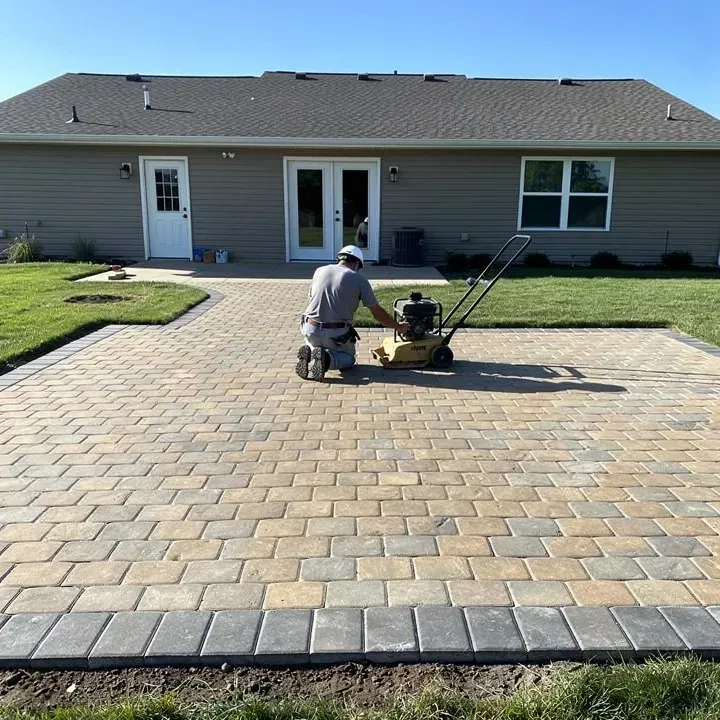
Once the base is ready, we install edge restraint along the border and spread a smooth, consistent layer of bedding sand, screeded to the correct level. The pavers are then laid by hand in your chosen pattern, with tight, even joints. We cut the pavers that meet the house, curves, and borders with a saw for clean, precise edges, and we check lines and levels as we go. After the pavers are in place, we compact them into the sand bed, sweep polymeric joint sand into every joint, and compact once more so the surface locks together.
To finish, we activate the joint sand, clean the entire surface, and restore the surrounding area, including grading soil along the edges and removing all debris. We then walk the finished patio with you and review simple care tips so you know how to keep it looking great. You get a patio that is stable, level, drains well, and is ready to use right away.
Paver Patio Cost Factors Explained
The cost of a paver patio depends on several factors, and understanding them helps you plan with confidence. Size is the biggest one, since a larger patio requires more material, more excavation, and more labor. Shape matters too. A simple rectangle is more efficient to build than a design with curves, angles, and multiple levels, which require more cutting and layout time.
The type of paver you choose also affects the price. Standard concrete pavers are the most budget-friendly, while premium concrete pavers, large-format pavers, natural stone, and specialty textures cost more. Pattern plays a role as well, because a basic running bond is quicker to install than a complex herringbone or a mix of patterns with borders and inlays.
Site conditions have a major impact. If we need to remove an old concrete slab or existing pavers, haul away material, or deal with soft soil, tree roots, or a steep slope, the project takes more time and more material. Drainage is another factor. Surfaces that need extra base depth, drain pipe, or channel drains to move water safely away from your home will cost more, but they protect your investment. Access also matters, because limited access for equipment and material deliveries can increase labor time.
Finally, add-ons will change the total. Fire pits, seating walls, steps, planting beds, lighting, and connecting walkways are popular upgrades that add function and character to the space. We go over each of these during your free estimate, show you what drives the price on your specific project, and, if you are working within a budget, help you find ways to phase the work or adjust the design so you get the most value.
Frequently Asked Questions
How long does a paver patio last?
A properly installed paver patio can last 25 years or more. The key is the base, since pavers only stay flat and tight when they sit on a deep, well-compacted aggregate foundation with proper drainage. Because the surface is made of individual interlocking units, it flexes with ground movement instead of cracking, and individual pavers can be replaced if they are ever damaged or stained. Simple upkeep like sweeping, rinsing, and refreshing joint sand every few years keeps it looking new.
Are paver patios slippery when wet?
Not when the right paver is chosen. We recommend pavers with a matte, textured surface that gives good traction when wet, which is especially important near pool areas, steps, and shaded spots. Polymeric joint sand also fills the joints so water drains away rather than pooling on top. During your estimate, we can show you samples so you can see and feel the options.
Can you build a patio around an existing fire pit, grill, or seating wall?
Yes. We design the patio around how you plan to use the space, so we can include a built-in fire pit, a grill area, seating walls, steps, and a walkway connecting to other parts of your yard. If you already have a feature you want to keep, we will plan the layout and grading around it. Share your ideas with us during the free estimate and we will walk you through the best options for your yard and budget.
Can you remove my old concrete patio or existing pavers?
Yes, we handle the whole job. We remove and haul away the old surface, inspect the soil underneath, and rebuild with a proper base. In some cases we can reuse your existing pavers if they are in good condition, which can reduce material costs. We will let you know during the estimate whether reuse is a good option or whether new pavers will give you a better result.
Let's Build the Paver Project You Have Been Picturing!
Whether you are dealing with a sinking walkway, a cracked driveway, or a backyard you have never been able to enjoy, we are ready to help. Call Vineland Paver Pros today or fill in our form to schedule your free on-site estimate. We will walk your property, answer your questions, and give you a clear written price with no pressure and no obligation.



Contact
(856) 440-6076
Mon–Sat: 6am–6pm
Vineland, NJ
About Us
Based in Vineland, we help local homeowners turn worn or unused outdoor areas into durable, beautiful spaces. Our experienced crew focuses on craftsmanship, upfront pricing, and respect for your property. We are proud to serve Vineland and communities throughout southern New Jersey.
© Copyright 2026 Vineland Paver Pros. All rights reserved.
© Copyright 2026 Vineland Paver Pros.
All rights reserved.